
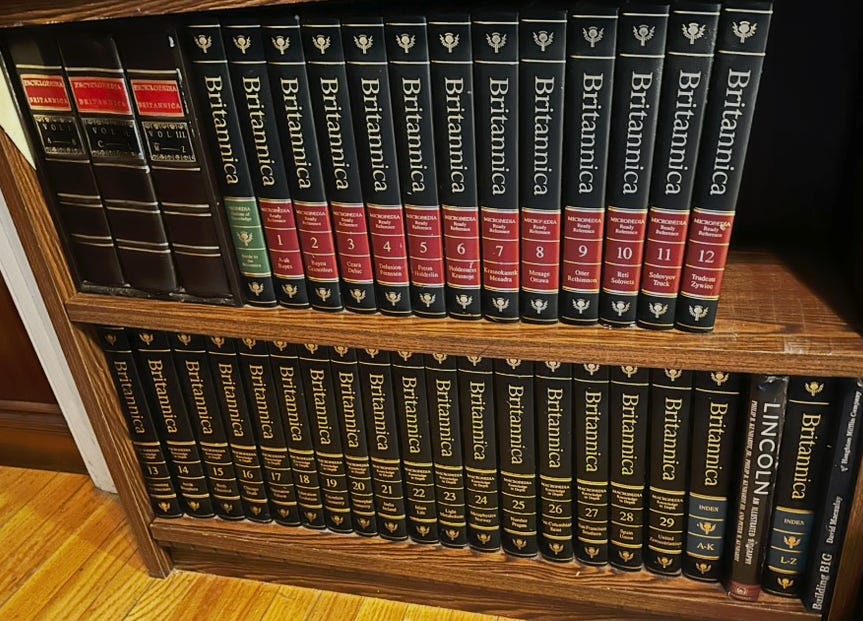
The end of an era came to my house this past weekend. I finally gave away my 1993 set of Encyclopædia Britannica. It was gathering dust on a bookcase, and my three kids hadn’t opened a volume in more than 10 years. So I finally gave in to the Declutter Police, boxed them up, and put them on the porch to give away on the Buy Nothing app, where you can connect with people for neighborhood giveaways.
I gave them away and asked for nothing for a few reasons.
First, after researching where I could donate them, I learned that libraries and schools generally don’t take them. They take up too much room, and older ones are outdated. While most knowledge prior to 1993 has remained intact, back then, Pluto was still a planet, and a number of independent countries didn’t exist then (Serbia, Montenegro, South Sudan, to name a few).
Second, for many years, I’ve gone on eBay to follow people trying to sell their sets for up to $299, and they never move. My mother-in-law still has a set from 1953, and you’d think it might be a collector’s item, but even that version doesn’t get any interested parties willing to pay.
But mostly, I was fine giving it away because I never paid for it myself. I got it for free.
My first job out of college was working for Britannica. Back then, if you stayed there for a while, you’d get a free set every five years. I was there for nine-and-a-half years, so I was very close to getting a second set.
Several years later, in 2010, Britannica literally stopped the presses and halted its print edition. Their flagship product is now available only online. (I worked on their earliest online editions while there.) Though it has been more than a quarter century since I worked there, I still subscribe to their online edition, perhaps out of a sense of loyalty or reminiscence, despite so much free information available online. (Even Wikipedia was originally based on an old, public-domain version of Britannica when it first started.) But as we know, there is so much non-authoritative, unvetted information poisoning the world right now—not to mention deliberate lies, misinformation, and obfuscations—that having a trusted source is vital now more than ever.
But one thing that I’ll miss about combing through the Britannica set is the serendipity of learning. When you look something up in a printed encyclopedia—”starting with the index!” as the company’s Indexing Department always insisted—you’d go to a page to find what you’re looking for, and across the page you’d find a photo of an exotic city, an odd-looking animal, a map of an unfamiliar part of the world, or countless other things that you weren’t looking for, and then, suddenly, you knew about them. Knowledge wasn’t just a place you landed on—it was a river that took you in all sorts of different directions.
For the geeked-out kid who loved to read, this was a godsend for them and their parents, almost a kind of built-in babysitting. Kids could sit for hours just discovering knowledge. I suppose this was a source of entertainment before television came along.
Nowadays, in addition to kids being sidetracked by social media, knowledge has become an environment where you focus on one specific subject, look up and learn what you need to know, and then you’re done. Why be sidetracked by stuff you’re not looking for? Who needs to waste that time when there are silly AI videos of people dancing badly on TikTok?
You can, of course, go to a library to retain this sense of serendipitous learning. But online, the closest thing I can find is the “I’m feeling lucky” button on Google’s home page, which returns a random set of search results. Apparently, only 1% of users click on it, resulting in a huge loss of revenue. (Ah, let us cry for the poor trillion-dollar company.) And who goes to the Google home page anymore when you can search in your browser bar? I went there just now, and unsurprisingly, I saw that they’ve replaced the “lucky” button with one that rotates “trendy,” “playful,” “artistic,” “fun,” and surely many more. Maybe “trendy” or “fun” cut their losses.
Just as specialization took over universities decades ago and replaced the idea of being a well-rounded person (and good citizen) with majors and concentrations, now we’ve moved from specialized knowledge to need-to-know knowledge. Anything can be looked up instantly just by talking to Google, Siri, and other chatbots and search engines. AI has given us generative answers that go beyond search results to explanations. The next step may be more widespread use of wearables like glasses, where we can see our answers, have them explained via videos against a backdrop of the real world, and even be taken places with VR walkthroughs. And then, further down the line, all of this could be injected into our brains.
Perhaps someone then, or now, can find a way to inject some serendipity into this process. Instead of Claude asking me whether I’d like to dig into a subject further and go down a rabbit hole on a certain question, it might end with the equivalent of a random “did you know?” response. Rather than give us more of what we want, it could provide us with the opposite of what we want from time to time, something to broaden our knowledge and give us something else to talk about.
Until then, I’m going to make the occasional online pilgrimage to Britannica.com and ask the chatbot to give me a random piece of knowledge. Here’s the one it gave me today:
The Great Wall of China was constructed to fortify China’s northern border. It has been the site of numerous battles and skirmishes throughout history, including conflicts with the Xiongnu during the Qin dynasty, the Khitans during the Song dynasty, and the Mongols during the Ming dynasty.
Would you like to explore more about the history of the Great Wall of China or perhaps another topic?
No, give me something totally unrelated. That’s how I expand my knowledge.